Copyright information
For more information, contact:
Immigration and Refugee Board of Canada
Minto Place, Canada Building
344 Slater Street, 12th floor
Ottawa, Ontario
Canada
K1A 0K1
© His Majesty the King in Right of Canada, as represented by the Minister of Immigration, Refugees and Citizenship, 2026.
Cat. No. MQ2-1 (Electronic PDF, English)
ISSN 2290-4751
On this page
Introduction and purpose of the
Privacy Act
The
Privacy Act (the Act) provides Canadian citizens, permanent residents or any person present in Canada with a right of access to their personal information being held by federal government institutions, subject to specific and limited exceptions. However, and as per the
Extension Order No. 3 dated July 13, 2022, all individuals have a general right of access under the Act to their personal information that is held by federal government institutions, whether they are within or outside Canada.
Section 72(1) of the Actrequires deputy heads of all government institutions to table an annual report on the administration of the Act within their respective institutions during each financial year.
This annual report provides a summary of the management and administration of the Act within the Immigration and Refugee Board of Canada (IRB) during the 2025-2026 reporting period. It is intended for use by the general public, members of Parliament, and IRB personnel.
Immigration and Refugee Board of Canada
The IRB is Canada’s largest independent administrative tribunal. It is responsible for resolving immigration and refugee cases efficiently, fairly and in accordance with the law.
The IRB is composed of four divisions:
- The Refugee Protection Division (RPD), which decides:
- claims for refugee protection made within Canada;
- applications for vacation of refugee protection; and
- applications for cessation of refugee protection.
- The Immigration Division (ID), which conducts:
- admissibility hearings for foreign nationals or permanent residents who seek entry into Canada, or who are already in Canada and are alleged to be inadmissible; and
- detention reviews for foreign nationals or permanent residents who are detained for immigration reasons.
- The Immigration Appeal Division (IAD), which hears:
- appeals of family sponsorship applications refused by Immigration, Refugees and Citizenship Canada (IRCC);
- appeals from certain removal orders made against permanent residents, Convention refugees and other protected persons, and holders of permanent resident visas;
- appeals by permanent residents against whom an IRCC officer outside of Canada has decided that they have not fulfilled their residency obligation; and
- appeals by the Minister of Public Safety of ID decisions at admissibility hearings.
- The Refugee Appeal Division (RAD) which hears:
- appeals from decisions of the RPD allowing or rejecting claims for refugee protection;
- appeals from decisions of the RPD rejecting applications by the Minister for a determination that refugee protection has ceased; and
- appeals from decisions of the RPD rejecting applications by the Minister to vacate a decision to allow a claim for refugee protection.
The Chairperson of the IRB reports to Parliament through the Minister of Immigration, Refugees and Citizenship Canada.
Of note, the IRB has not had any wholly owned subsidiary at any time during the reporting period.
Communications and Access to Information Directorate
The Communications and Access to Information Directorate ensures that the IRB meets its statutory obligations under the
Access to Information Act and the
Privacy Act by:
- processing access and privacy requests made to the IRB;
- responding to consultation requests submitted by other federal institutions;
- providing advice and guidance to IRB personnel regarding the interpretation of both acts as well as related Treasury Board of Canada Secretariat (TBS) policies and guidelines;
- liaising on behalf of the IRB with the TBS, the offices of the Information Commissioner and the Privacy Commissioner and other government departments and agencies on a wide variety of ATIP-related issues ranging from legislative interpretation to details of process and procedures;
- providing input into the development of IRB policies and procedures to ensure that they comply with the provisions of both acts;
- coordinating the preparation of the IRB’s
Info Source chapter;
- preparing the annual reports to Parliament on the administration of each act; and
- participating in ATIP forums such as the TBS-led ATIP Community meetings and working groups.
The Access to Information and Privacy (ATIP) Unit, which is within the Communications and Access to Information Directorate is part of the Strategic Directions and Corporate Affairs Branch and includes the following positions: a manager/coordinator, a supervisor, five ATIP officers and two clerks. In the Fall of 2025, the IRB also hired a total of 10 consultants to help manage the increased workload and contribute to the efficient processing of requests.
Although section 73.1 of the
Privacy Act allows institutions reporting to the same Minister to enter into agreements with each other for the purpose of sharing ATIP resources and capacity, the IRB did not have any such service agreement for the reporting period.
Delegation of authority
Pursuant to section 73(1) of the
Privacy Act, the deputy head of a government institution may by order designate one or more officers or employees of the institution to exercise or perform any of the powers, duties or functions of the deputy head of the institution.
Authority to exercise the powers and perform the duties and functions of the Chairperson (deputy head) of the IRB for the purposes of the Act has been delegated to the Executive Director, the Director General of the Strategic Directions and Corporate Affairs Branch, the Director of Communications and Access to Information Directorate, the ATIP Manager/Coordinator and the ATIP supervisor.
The Chief Security Officer, the Deputy Chief Security Officer and the National Emergency Management Coordinator are solely responsible for authorizing the disclosure of personal information deemed to be in the public interest under paragraph 8(2)(m) of the Act, while the Assistant Deputy Chairperson or Registrar may authorize the disclosure of information pursuant to paragraph 8(2)(b).
A copy of the delegation order is enclosed at
Appendix A.
Performance on the
Privacy Act, 2025—2026
The following provides an overview of the statistical information contained in
Appendix B of this report.
Section 1: Completed requests under the
Privacy Act
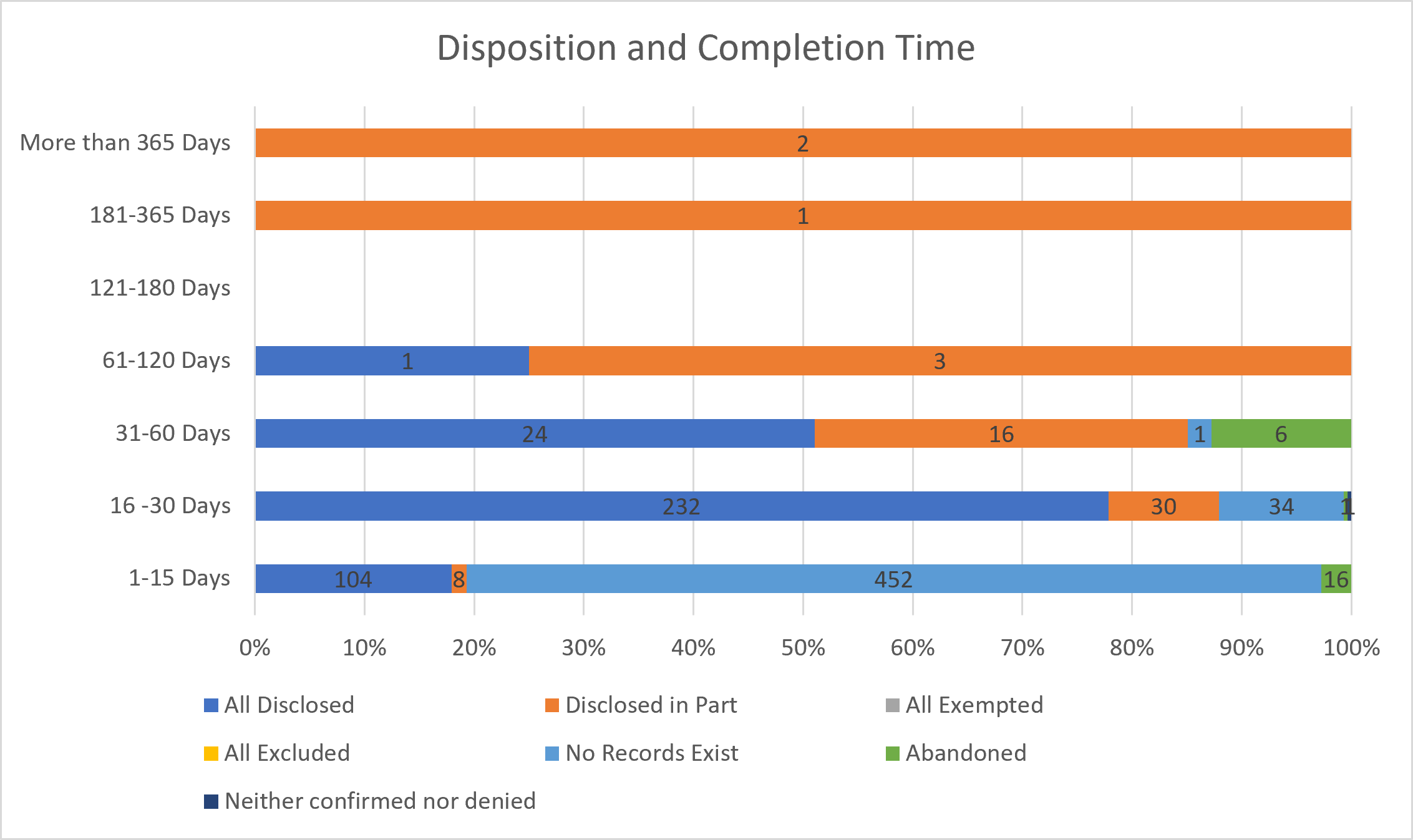
During 2025-26, 919 requests were closed by the IRB within legislated timeframe, which represents 98.6% of requests. This reflects an increase in timeliness from 2024-25 when 94.4% of requests were closed on time. Moreover 38.7% of requests were All Disclosed and 6.4% of requests were Disclosed in Part. The chart below summarizes the length of time required to process the 932 requests completed in 2025–26.
Text version: Disposition and Completion Time
Disposition and Completion Time
| All disclosed | Disclosed in part | All exempted | All excluded | No records exist | Abandoned | Neither confirmed nor denied |
|---|
| More than 365 days | 0 | 2 | 0 | 0 | 0 | 0 | 0 |
|---|
| 181-365 days | 0 | 1 | 0 | 0 | 0 | 0 | 0 |
|---|
| 121-180 days | 0 | 0 | 0 | 0 | 0 | 0 | 0 |
|---|
| 61-120 days | 1 | 3 | 0 | 0 | 0 | 0 | 0 |
|---|
| 31-60 days | 24 | 16 | 0 | 0 | 1 | 6 | 0 |
|---|
| 16-30 days | 232 | 30 | 0 | 0 | 34 | 1 | 1 |
|---|
| 1-15 days | 104 | 8 | 0 | 0 | 452 | 16 | 0 |
|---|
Overall, the IRB responded to a total of:
- 580 requests within 15 days (62%);
- 298 requests within 16-30 days (32%);
- 47 requests within 31-60 days (5%);
- 4 requests within 61-120 days (0.4%);
- 1 request within 181-365 days (0.1%); and
- 2 requests in more than 365 days (0.2%).
In regard to the abandoned cases, the applicants either failed to provide sufficient information to allow the IRB to find the requested documentation or failed to obtain written consent from another individual to authorize the IRB to release the personal information.
Furthermore, a total of 487 requests (52%) could not be processed, as no relevant records existed.
Section 2: Active Requests under the
Privacy Act
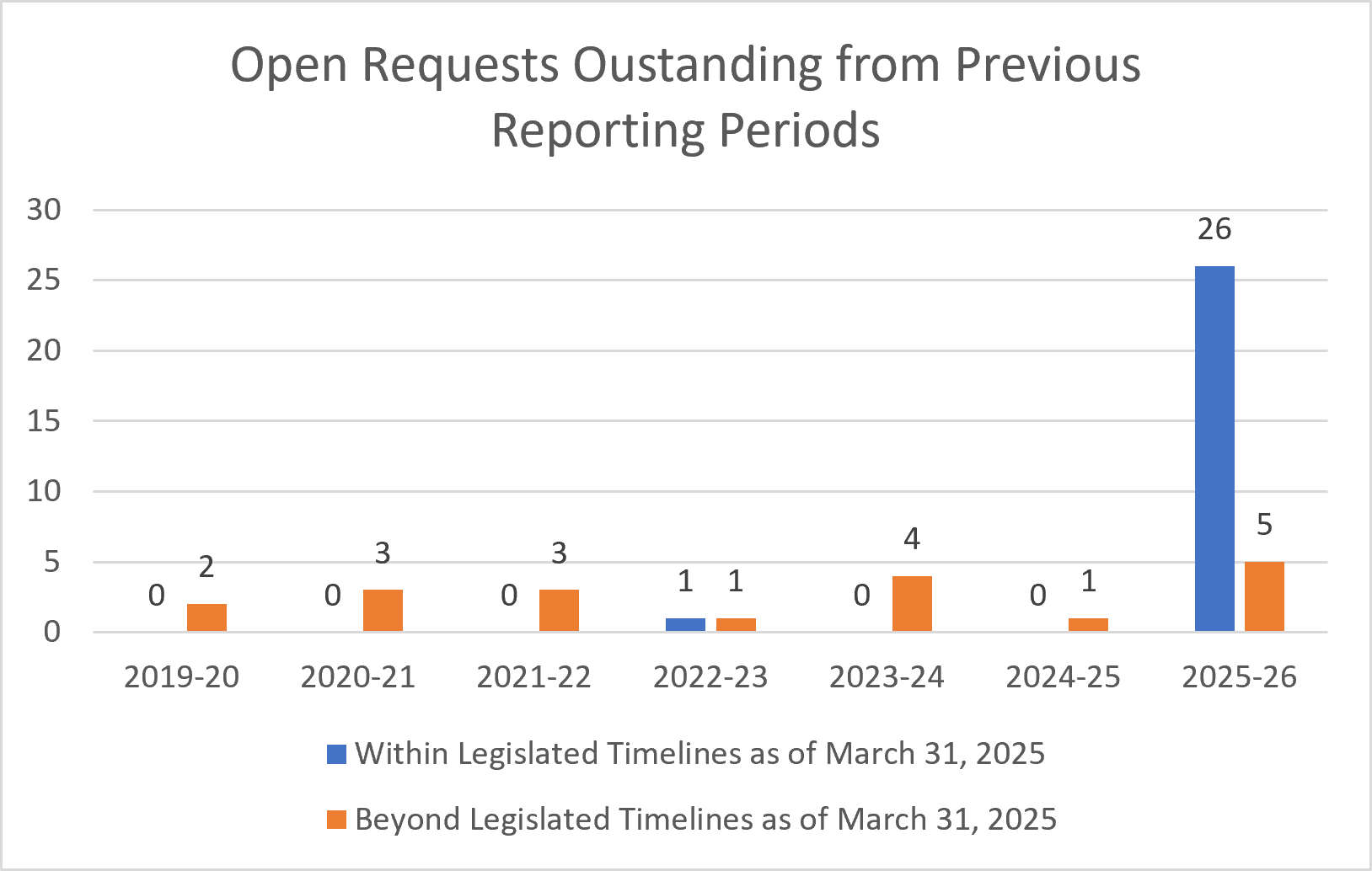
At the end of the reporting period, 46 requests were carried over to fiscal year 2026–27. As of March 31, 2026, 27 of these requests were processed within the legislated timelines and 19 requests were beyond the legislated timelines.
Text version: Open Requests Outstanding from Previous Reporting Periods
Open Requests Outstanding from Previous Reporting Periods
| Year | Within Legislated timelines as of March 31, 2025 | Beyond Legislated Timelines as of March 31, 2025 |
|---|
| 2019-2020 | 0 | 2 |
|---|
| 2020-2021 | 0 | 3 |
|---|
| 2021-2022 | 0 | 3 |
|---|
| 2022-2023 | 1 | 1 |
|---|
| 2023-2024 | 0 | 4 |
|---|
| 2024-2025 | 0 | 1 |
|---|
| 2025-2026 | 26 | 5 |
|---|
Section 3: Extensions
Section 15 of the Act allows government institutions to extend the statutory 30-day time limit for processing a request.
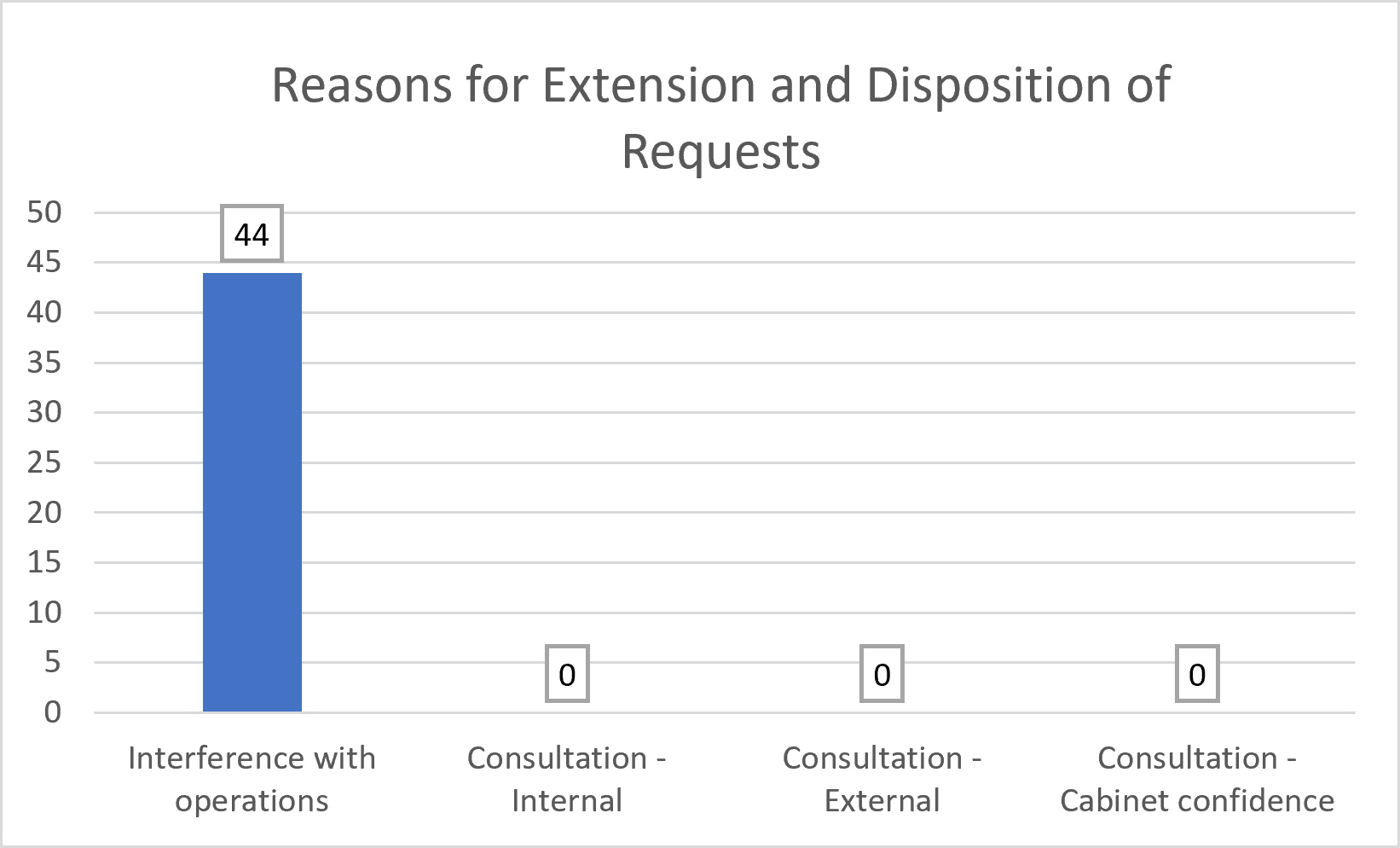
During 2025-26, 44 extensions were taken based on interference with operations.
Text version: Reasons for Extensions and Disposition of Requests
Reasons for Extension and Disposition of Requests
| Interference with operations | Consultation - internal | Consultation - external | Consultation - cabinet confidence |
|---|
| 44 | 0 | 0 | 0 |
The length of extension that was taken for all 44 extensions was for 16 to 30 days.
Section 4: Consultations received from other institutions and organizations
In 2025-26 there were 2 consultations received from other institutions and organizations.
Both consultation requests were received from another government of Canada institution. All records sought were disclosed entirely and both consultations were completed within 15 days.
Section 5: Summary of key issues and actions taken on complaints
In fiscal year 2025-26, 1 new complaint was filed with the Office of the Privacy Commissioner of Canada against the IRB. This 1 complaint represents 0.1% of all privacy requests received during 2025-2026. The IRB also resolved 2 complaints over the course of the fiscal year. The chart below summarizes the number of active complaints at the end of the fiscal year.
| Reporting period active complaints were received by institution | Number of active complaints |
|---|
| Received in 2023-2024 | 2 |
Actions that were taken by the IRB during the reporting period to resolve privacy complaints involved conducting new searches to validate if any records existed and which had not been provided when initially processing the requests.
Section 6: Privacy Impact Assessments (PIAs)
During 2025-26, no Privacy Impact Assessments were completed or modified. All existing PIAs are publicly available on
IRB’s website.
Section 7: Material Privacy Breaches
No material privacy breaches were reported during 2025-26.
Section 8: Public Interest Disclosures
During 2025-26, the IRB made no disclosures pursuant to paragraph 8(2)(m) of the
Privacy Act.
Training and awareness
Monitoring activities
The manager, in cooperation with the supervisor and analysts, monitors the processing times for privacy requests, on a weekly basis and provides a high-level report to senior management on deadlines at-risk. In addition, ATIP staff periodically perform diagnostic activities related to the processing of the various requests received. Trends in the requested information are monitored to identify if any frequently requested types of information can be made available via other means.
The ATIP Unit follows the
Access to Information Implementation Notice 2022-01: Inter-institutional Consultations and only consults other institutions when more information is needed or when the institution wishes to disclose potentially sensitive information.
Education and training activities
Appendix B of the
Directive on Personal Information Requests and Correction of Personal Information sets out mandatory training requirements. In order to ensure all employees have completed the mandatory privacy training set out in this directive, the ATIP office delivered one (1) awareness session to 20 individuals. Individual and informal training sessions were also offered to IRB employees on request.
Employees with functional responsibility for the administration of the
Privacy Act and
Privacy Regulations were encouraged to take additional in-depth training to support them in their functions.
Policies, guidelines, procedures, and initiatives
Privacy implementation notice
The IRB continues to implement the
Privacy Implementation Notice 2020-03: Protecting privacy when releasing information about a small number of individuals during the 2025–26 reporting period, to prevent inadvertent identification of individuals from small data sets in highly sensitive contexts (e.g., refugee claims).
Initiatives and Projects to Improve Privacy
The ATIP Unit continues to work with the IM/IT team to work on the acquisition and implementation of the new Request Processing Software Solution (RPSS). Once the software is in place, it will increase the efficiency of the processing of requests and modernize the delivery of services.
Social Insurance Number (SIN)
The IRB did not receive authority for a new collection or new consistent use of the SIN in 2025–2026.
Privacy Protections in Contracts, Agreements or Arrangements
Where a contract requires the Contractor to access, collect, use, store, disclose, or otherwise handle personal information in the performance of the Work, the IRB typically includes the Personal Information clause (formerly SACC Manual Clause 4008) in the contract.
This clause contains a number of privacy protections, including but not limited to:
- Restrictions on the collection, use, disclosure, retention, and disposal of personal information;
- Requirements to collect only the personal information necessary to perform the Work;
- Obligations to safeguard personal information and protect its confidentiality and integrity;
- Access controls and security measures to prevent unauthorized access;
- Mandatory notification of security breaches involving personal information;
- Restrictions on subcontracting and third-party storage of personal information without prior approval;
- Requirements to maintain audit trails and records relating to personal information;
- Appointment of a privacy officer by the Contractor;
- Reporting obligations relating to the handling of personal information;
- Audit rights allowing Canada to verify contractor compliance; and
- Requirements to return all records containing personal information to Canada upon request or at contract completion.
In addition, where appropriate, the IRB may include a Non-Disclosure Agreement (NDA) as part of the contract, requiring the Contractor and its resources to protect confidential information obtained in the course of performing the Work.
Appendix A - Delegation orders (Privacy Act)
The Chairperson of the Immigration and Refugee Board of Canada, pursuant to section 73(1) of the
Privacy ActFootnote 1, hereby designates the persons holding the positions set out in the schedule below, or the persons occupying on an acting basis those positions, to exercise the powers, duties and functions of the Chairperson as the head of the Immigration and Refugee Board of Canada, under the provisions of the Act and related regulations set out in the Schedule opposite each position. This designation replaces all previous delegation orders.
Dated, at the City of Ottawa, this 23 day of October, 2023.
Manon Brassard,
Chairperson
Schedule
| Position |
Privacy Act and Regulations |
|---|
| Chairperson | Full authority |
| Executive Director | Full Authority except: subsection 73(1) Regulations: Full Authority |
Director General, Strategic Directions and Corporate Affairs Branch Director, Communications and Access to Information Directorate Manager, Access to Information and Privacy Supervisor, Access to Information and Privacy | Full Authority except: paragraph 8(2)(m) and subsection 73(1) Regulations: Full Authority |
Chief Security Officer Deputy Chief Security Officer National Emergency Management Coordinator | Only for situations where there is a safety or security threat : paragraph 8(2)(m) |
| Assistant Deputy Chairperson or Registrar | Only for disclosures under section 13.1 of the
Immigration and Refugee Protection Regulations: paragraph 8(2)(b) |
Appendix B - Statistical report on the
Privacy Act
Section 1: Requests under the
Privacy Act
1.1 Number of requests
| - | Number of requests |
|---|
| Received during reporting period | 907 |
Outstanding from previous reporting periods
- Outstanding from previous reporting period: 57
- Outstanding from more than one reporting period: 14
| 71 |
| Total | 978 |
| Closed during reporting period | 932 |
Carried over to next reporting period
- Carried over within legislated timeline: 27
- Carried over beyond legislated timeline: 19
| 46 |
1.2 Channels of requests
| Source | Number of requests |
|---|
| Online | 377 |
| Email | 528 |
| Mail | 2 |
| In person | 0 |
| Phone | 0 |
| Fax | 0 |
| Total | 907 |
Section 2: Informal requests
2.1 Number of informal requests
| - | Number of requests |
|---|
| Received during reporting period | 1 |
Outstanding from previous reporting periods
- Outstanding from previous reporting period: 0
- Outstanding from more than one reporting period: 0
| 0 |
| Total | 1 |
| Closed during reporting period | 1 |
| Carried over to next reporting period | 0
|
2.2 Completion time of informal requests
| 1 to 15 days | 16 to 30 days
| 31 to 60 days
| 61 to 120 days
| 121 to 180 days
| 181 to 365 days
| More than 365 days | Total |
|---|
| 0 | 1 | 0 | 0 | 0 | 0 | 0 | 1 |
2.3 Pages released informally
| Less than 500 pages released | 500 to 10,000 pages released | More than 10,000 pages released |
|---|
| Number of requests | Pages released | Number of requests | Pages released | Number of requests | Pages released |
|---|
| 0 | 282 | 0 | 0 | 0 | 0 |
Section 3: Requests closed during the reporting period
3.1 Disposition and completion time
| Disposition of requests | Completion time |
|---|
| 1 to 15 days | 16 to 30 days | 31 to 60 days | 61 to 120 days | 121 to 180 days | 181 to 365 days | More than 365 days | Total |
|---|
| All disclosed | 104 | 232 | 24 | 1 | 0 | 0 | 0 | 361 |
| Disclosed in part | 8 | 30 | 16 | 3 | 0 | 1 | 2 | 60 |
| All exempted | 0 | 0 | 0 | 0 | 0 | 0 | 0 | 0 |
| All excluded | 0 | 0 | 0 | 0 | 0 | 0 | 0 | 0 |
| No records exist | 452 | 34 | 1 | 0 | 0 | 0 | 0 | 487 |
| Request abandoned | 16 | 1 | 6 | 0 | 0 | 0 | 0 | 23 |
| Neither confirmed nor denied | 0 | 1 | 0 | 0 | 0 | 0 | 0 | 1 |
| Total | 580 | 298 | 47 | 4 | 0 | 1 | 2 | 932 |
3.2 Exemptions
| Section | Number of requests |
|---|
| 18(2) | 0 |
| 19(1)(a) | 1 |
| 19(1)(b) | 0 |
| 19(1)(c) | 0 |
| 19(1)(d) | 0 |
| 19(1)(e) | 0 |
| 19(1)(f) | 0 |
| 20 | 0 |
| 21 | 0 |
| 22 | 0 |
| 22(1)(a)(i) | 0 |
| 22(1)(a)(ii) | 0 |
| 22(1)(a)(iii) | 0 |
| 22(1)(b) | 1 |
| 22(1)(c) | 0 |
| 22(2) | 0 |
| 22.1 | 0 |
| 22.2 | 0 |
| 22.3 | 0 |
| 22.4 | 0 |
| 23(a) | 0 |
| 23(b) | 0 |
| 24(a) | 0 |
| 24(b) | 0 |
| 25 | 0 |
| 26 | 53 |
| 27 | 4 |
| 27.1 | 0 |
| 28 | 0 |
3.3 Exclusions
| Section | Number of requests |
|---|
| 69(1)(a) | 0 |
| 69(1)(b) | 0 |
| 69.1 | 0 |
| 70(1) | 0 |
| 70(1)(a) | 0 |
| 70(1)(b) | 0 |
| 70(1)(c) | 0 |
| 70(1)(d) | 0 |
| 70(1)(e) | 0 |
| 70(1)(f) | 0 |
| 70.1 | 0 |
3.4 Format of information released
| Paper | Electronic | Other |
|---|
| E-record | Data set | Video | Audio |
|---|
| 1 | 419 | 0 | 2 | 94 | 0 |
3.5 Complexity
3.5.1 Relevant pages processed and disclosed for paper and e-record formats
| Number of pages processed | Number of pages disclosed | Number of requests |
|---|
| 324,729 | 184,990 | 420 |
3.5.2 Relevant pages processed per request disposition for paper and e-record formats by size of requests
| Disposition | Less than 500 pages processed | 500 to 1000 pages | More than 10,000 pages |
|---|
| Number of requests | Pages processed | Number of requests | Pages processed | Number of requests | Pages processed |
|---|
| All disclosed | 253 | 29,838 | 107 | 163,017 | 0 | 0 |
| Disclosed in part | 21 | 5,030 | 37 | 89,497 | 2 | 37,347 |
| All exempted | 0 | 0 | 0 | 0 | 0 | 0 |
| All excluded | 0 | 0 | 0 | 0 | 0 | 0 |
| Request abandoned | 0 | 0 | 0 | 0 | 0 | 0 |
| Neither conformed nor denied | 0 | 0 | 0 | 0 | 0 | 0 |
| Total | 274 | 34,868 | 144 | 252,514 | 2 | 37,347 |
3.5.3 Relevant minutes processed and disclosed for audio formats
| Number of minutes processed | Number of minutes disclosed | Number of requests |
|---|
| 18,104 | 18,014 | 96 |
3.5.4 Relevant minutes processed per request disposition for audio formats by size of requests
| Disposition | Number of requests | Minutes processed |
|---|
| All disclosed | 79 | 13,221 |
| Disclosed in part | 17 | 4,883 |
| All exempted | 0 | 0 |
| All excluded | 0 | 0 |
| Request abandoned | 0 | 0 |
| Neither confirmed nor denied | 0 | 0 |
| Total | 96 | 18,104 |
3.5.5 Other complexities
| Disposition | Consultation required | Legal advice sought | Interwoven information | Other | Total |
|---|
| All disclosed | 0 | 2 | 29 | 19 | 50 |
| Disclosed in part | 0 | 3 | 2 | 20 | 25 |
| All exempted | 0 | 0 | 0 | 0 | 0 |
| All excluded | 0 | 0 | 1 | 0 | 1 |
| Request abandoned | 0 | 0 | 2 | 0 | 2 |
| Neither confirmed nor denied | 0 | 0 | 0 | 0 | 0 |
| Total | 0 | 5 | 34 | 39 | 78 |
3.6 Closed requests
3.6.1 Requests closed within the legislated timelines
| Number of requests closed within legislated timelines | Percentage of requests closed within legislated timelines |
|---|
919
| 98.60515021 |
3.7 Deemed refusals
3.7.1 Reasons for not meeting legislated timelines
| Number of requests closed past the legislated timelines | Principal reason |
|---|
| Interference with operations/workload | External consultation | Internal consultation | Other |
|---|
| 13 | 11 | 0 | 0 | 2 |
3.7.2 Requests closed beyond legislated timelines (including any extension taken)
| Number of days past legislated timelines | Number of requests past legislated timeline where no extension was taken | Number of requests past legislated timeline where an extension was taken | Total |
|---|
| 1 to 15 days | 6 | 0 | 6 |
| 16 to 30 days | 3 | 0 | 3 |
| 31 to 60 days | 1 | 0 | 1 |
| 61 to 120 days | 0 | 0 | 0 |
| 121 to 180 days | 0 | 0 | 0 |
| 181 to 365 days | 0 | 1 | 1 |
| More than 365 days | 1 | 1 | 2 |
| Total | 11 | 2 | 13 |
Section 4: Disclosures under subsections 8(2) and 8(5)
| Paragraph 8(2)(e) | Paragraph 8(2)(m) | Subsection 8(5) | Total |
|---|
| 26 | 0 | 0 | 26 |
Section 5: Requests for correction of personal information and notations
| Disposition for correction requests received | Number |
|---|
| Notations attached | 0 |
| Requests for correction accepted | 0 |
| Total | 0 |
Section 6: Extensions
6.1 Reasons for extensions
| - | 15(a)(i) Interference with operations | 15(a)(ii) Consultation | 15(b) Translation purposes or conversion |
|---|
| Number of requests where an extension was taken | Further review required to determine exemptions | Large volume of pages | Large volume of requests | Documents are difficult to obtain | Cabinet Confidence Section (Section 70) | External | Internal |
|---|
| 44 | 0 | 44 | 0 | 0 | 0 | 0 | 0 | 0 |
6.2 Length of extensions
| - | 15(a)(i) Interference with operations | 15(a)(ii) Consultation | 15(b) Translation purposes or conversion |
|---|
| Length of extentions | Further review required to determine exemptions | Large volume of pages | Large volume of requests | Documents are difficult to obtain | Cabinet Confidence Section (Section 70) | External | Internal |
|---|
| 1 to 15 days | 0 | 0 | 0 | 0 | 0 | 0 | 0 | 0 |
| 16 to 30 days | 0 | 44 | 0 | 0 | 0 | 0 | 0 | 0 |
| 31 days or greater | - | - | - | - | - | - | - | 0 |
| Total | 0 | 44 | 0 | 0 | 0 | 0 | 0 | 0 |
Section 7: Consultations received from othe institutions and organizations
7.1 Consultations received from other Government of Canada institutions and other organizations
| Consultations | Other Government of Canada institutions | Number of pages to review | Other organizations | Number of pages to review |
|---|
| Received during the reporting period | 2 | 9 | 0 | 0 |
| Outstanding from the previous reporting period | 0 | 0 | 0 | 0 |
| Total | 2 | 9 | 0 | 0 |
| Closed during the reporting period | 2 | 9 | 0 | 0 |
| Carried over within negotiated timelines | 0 | 0 | 0 | 0 |
| Carried over beyond negotiated timelines | 0 | 0 | 0 | 0 |
7.2 Recommendations and completion time for consultations received from other Government of Canada institutions
| Recommendation | Number of days required to complete consultation requests |
|---|
| 1 to 15 days | 16 to 30 days | 31 to 60 days | 61 to 120 days | 121 to 180 days | 181 to 365 days | More than 365 days | Total |
|---|
| Disclose entirely | 2 | 0 | 0 | 0 | 0 | 0 | 0 | 2 |
| Disclose in part | 0 | 0 | 0 | 0 | 0 | 0 | 0 | 0 |
| Exempt entirely | 0 | 0 | 0 | 0 | 0 | 0 | 0 | 0 |
| Exclude entirely | 0 | 0 | 0 | 0 | 0 | 0 | 0 | 0 |
| Consult other institution | 0 | 0 | 0 | 0 | 0 | 0 | 0 | 0 |
| Other | 0 | 0 | 0 | 0 | 0 | 0 | 0 | 0 |
| Total | 2 | 0 | 0 | 0 | 0 | 0 | 0 | 2 |
7.3 Recommendations and completion time for consultations received from other organizations outside the Government of Canada
| Recommendation | Number of days required to complete consultation requests |
|---|
| 1 to 15 days | 16 to 30 days | 31 to 60 days | 61 to 120 days | 121 to 180 days | 181 to 365 days | More than 365 days | Total |
|---|
| Disclose entirely | 0 | 0 | 0 | 0 | 0 | 0 | 0 | 0 |
| Disclose in part | 0
| 0 | 0 | 0 | 0 | 0 | 0 | 0
|
| Exempt entirely | 0 | 0 | 0 | 0 | 0 | 0 | 0 | 0 |
| Exclude entirely | 0 | 0 | 0 | 0 | 0 | 0 | 0 | 0 |
| Consult other institution | 0 | 0 | 0 | 0 | 0 | 0 | 0 | 0 |
| Other | 0 | 0 | 0 | 0 | 0 | 0 | 0 | 0 |
| Total | 0 | 0 | 0 | 0 | 0 | 0 | 0 | 0 |
Section 8: Completion time of consultations on cabinet confidences
8.1 Requests with Legal Services
| Number of days | Fewer than 500 pages processed | 500 to 10,000 pages processed | More than 10,000 pages processed |
|---|
| Number of requests | Pages disclosed | Number of requests | Pages disclosed | Number of requests | Pages disclosed |
|---|
| 1 to 15 | 0 | 0 | 0 | 0 | 0 | 0 |
| 16 to 30 | 0 | 0 | 0 | 0 | 0 | 0 |
| 31 to 60 | 0 | 0 | 0 | 0 | 0 | 0 |
| 61 to 120 | 0 | 0 | 0 | 0 | 0 | 0 |
| 121 to 180 | 0 | 0 | 0 | 0 | 0 | 0 |
| 181 to 365 | 0 | 0 | 0 | 0 | 0 | 0 |
| More than 365 | 0 | 0 | 0 | 0 | 0 | 0 |
| Total | 0 | 0 | 0 | 0 | 0 | 0 |
8.2 Requests with Privy Council Office
| Number of days | Fewer than 500 pages processed | 500 to 10,000 pages processed | More than 10,000 pages processed |
|---|
| Number of requests | Pages disclosed | Number of requests | Pages disclosed | Number of requests | Pages disclosed |
|---|
| 1 to 15 | 0 | 0 | 0 | 0 | 0 | 0 |
| 16 to 30 | 0 | 0 | 0 | 0 | 0 | 0 |
| 31 to 60 | 0 | 0 | 0 | 0 | 0 | 0 |
| 61 to 120 | 0 | 0 | 0 | 0 | 0 | 0 |
| 121 to 180 | 0 | 0 | 0 | 0 | 0 | 0 |
| 181 to 365 | 0 | 0 | 0 | 0 | 0 | 0 |
| More than 365 | 0 | 0 | 0 | 0 | 0 | 0 |
| Total | 0 | 0 | 0 | 0 | 0 | 0 |
Section 9: Complaints and investigations notices received
| Section 31 | Section 33 | Section 35 | Court action | Total |
|---|
| 1 | 0 | 2 | 0 | 3 |
Section 10: Privacy Impact Assessments (PIAs) and Personal Information Banks (PIBs)
10.1 Programs and activities
| Number of existing programs or activities that use personal information that havebeen substantially modified during the reporting period | Number of new programs or new activities that use personal information established during the reporting period |
|---|
| 0 | 0 |
10.2 Privacy impact assessments
| Number of PIAs completed | Number of PIAs modified | Number of PIA summaries published during the reporting period | Number of PIAs for which the risk mitigation measures have been reviewed during the reporting period |
|---|
| 0 | 0 | 0 | 0 |
10.3 Privacy protocols
| Number of privacy protocols completed to establish or modify Personal Information Banks |
|---|
| 0 |
10.4 Institution-specific and Central Personal Information Banks
| Personal Information Banks | Active | Created | Terminated | Modified |
|---|
| Institution-specific | 7 | 0 | 0 | 0 |
| Central | 0 | 0 | 0 | 0 |
| Total | 7 | 0 | 0 | 0 |
10.5 Info source page
| Date of the most recent major change to Personal Information Banks on the Info Source page |
|---|
| 2018-07-05 |
Section 11: Social Insurance Number
| Number of new programs or activities that collect or use Social Insurance Number |
|---|
| 0 |
Section 12: Privacy breaches
12.1 Material privacy breaches reported
| Number of material privacy breaches reported to TBS | Number of material privacy breaches reported to OPC |
|---|
| 1 | 1 |
12.2 Non-material privacy breaches
| Number of non-material privacy breaches |
|---|
| 146 |
Section 13: Privacy training
| Number of employees that have completed privacy training during the reporting period |
|---|
| 20 |
Section 14: Resources related to the
Privacy Act
14.1 Allocated costs
| Expenditures | Amount |
|---|
| Salaries | $289,408 |
| Overtime | $39,545 |
Good and services
- Professional services contracts: $66,635
- Other: $0
| $66,635 |
| Total | $395,588 |
14.2 Human resources
| Resources | Person years dedicated to access to information activities |
|---|
| Full-time employees | 4.500 |
| Part-time and casual employees | 0.375 |
| Regional staff | 0.000 |
| Consultants and agency personnel | 0.000 |
| Students | 0.000 |
| Total | 4.875 |
Appendix C - Appendix C - Supplemental Statistical Report on the Access to Information Act and the Privacy Act
Section 1: Open requests and complaints under the
Access to Information Act
1.1 Requests carried over to the next reporting period, broken down by reporting period received
| Reporting period requests carried over were received | Requests carried over that are within legislated timelines as of March 31, 2026 | Requests carried over that are beyond legislated timelines as of March 31, 2026 | Total |
|---|
| Received in 2025-2026 | 17 | 7 | 24 |
| Received in 2024-2025 | 4 | 7 | 11 |
| Received in 2023-2024 | 0 | 7 | 7 |
| Received in 2022-2023 | 232 | 3 | 235 |
| Received in 2021-2022 | 0 | 8 | 8 |
| Received in 2020-2021 | 2 | 1 | 3 |
| Received in 2019-2020 | 0 | 2 | 2 |
| Received in 2018-2019 | 0 | 1 | 1 |
| Received in 2017-2018 | 0 | 0 | 0 |
| Received in 2016-2017 or earlier | 0 | 0 | 0 |
| Total | 255 | 36 | 291 |
1.2 Active complaints with the Information Commissioner of Canada, broken down by reporting period received
| Reporting period active complaints were received by institution | Number of active complaints |
|---|
| Received in 2025-2026 | 3 |
| Received in 2024-2025 | 3 |
| Received in 2023-2024 | 1 |
| Received in 2022-2023 | 4 |
| Received in 2021-2022 | 3 |
| Received in 2020-2021 | 1 |
| Received in 2019-2020 | 0 |
| Received in 2018-2019 | 0 |
| Received in 2017-2018 | 0 |
| Received in 2016-2017 or earlier | 0 |
| Total | 15 |
Section 2: Requests carried over and active complaints under the
Privacy Act
2.1 Requests carried over to next reporting period, broken down by reporting period received
| Reporting period requests carried over were received | Requests carried over that are within legislated timelines as of March 31, 2026 | Requests carried over that are beyond legislated timelines as of March 31, 2026 | Total |
|---|
| Received in 2025-2026 | 26 | 5 | 31 |
| Received in 2024-2025 | 0 | 1 | 1 |
| Received in 2023-2024 | 0 | 4 | 4 |
| Received in 2022-2023 | 1 | 1 | 2 |
| Received in 2021-2022 | 0 | 3 | 3 |
| Received in 2020-2021 | 0 | 3 | 3 |
| Received in 2019-2020 | 0 | 2 | 2 |
| Received in 2018-2019 | 0 | 0 | 0 |
| Received in 2017-2018 | 0 | 0 | 0 |
| Received in 2016-2017 or earlier | 0 | 0 | 0 |
| Total | 27 | 19 | 46 |
2.2 Active complaints with the Privacy Commissioner of Canada, broken down by reporting period received
| Reporting period active complaints were received by institution | Number of active complaints |
|---|
| Received in 2025-2026 | 0 |
| Received in 2024-2025 | 0 |
| Received in 2023-2024 | 2 |
| Received in 2022-2023 | 0 |
| Received in 2021-2022 | 0 |
| Received in 2020-2021 | 0 |
| Received in 2019-2020 | 0 |
| Received in 2018-2019 | 0 |
| Received in 2017-2018 | 0 |
| Received in 2016-2017 or earlier | 0 |
| Total | 2 |
Section 3: Universal access under the
Privacy Act
| How many requests were received from foreign nationals outside of Canada in 2025-2026? | 30 |